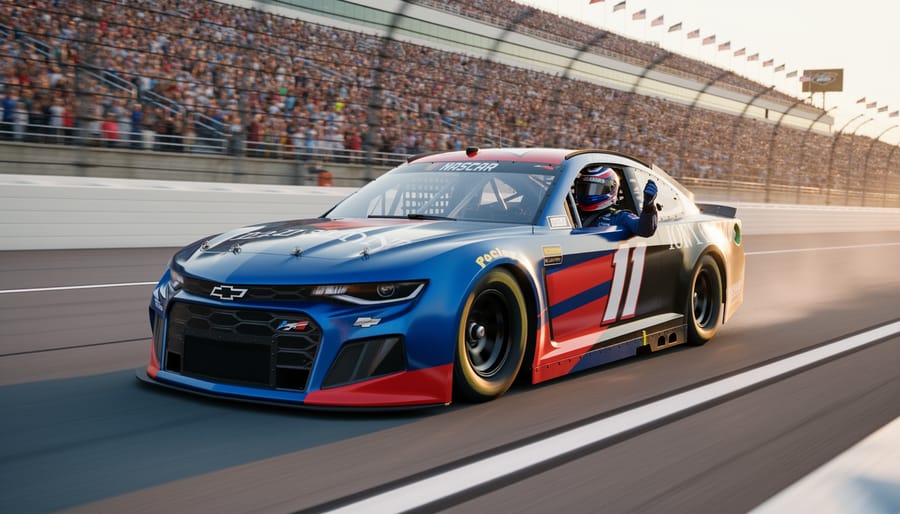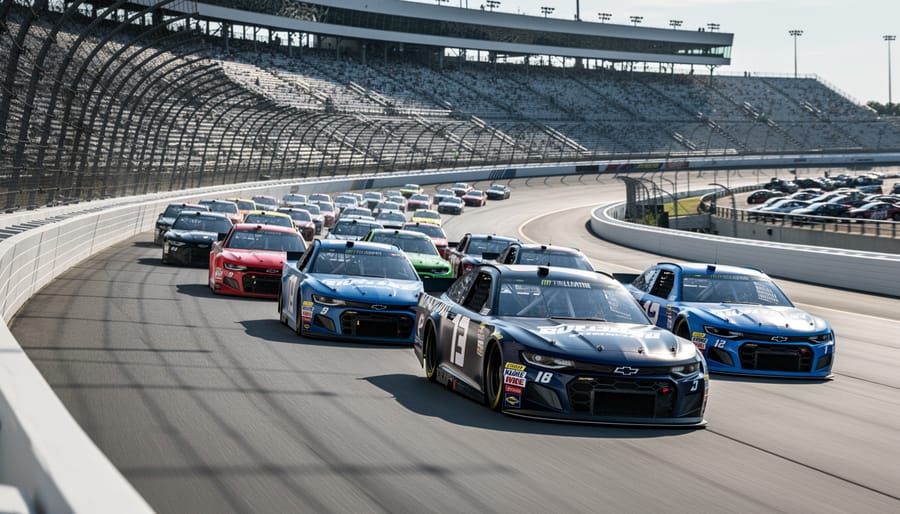
NASCAR’s return to Talladega Superspeedway on October 23-25, 2026 marks one of the sport’s most anticipated playoff weekends, where 40 cars will hurtle through Alabama at speeds topping 200 mph in the closest pack racing anywhere in motorsports. The Chase weekend at Talladega stands apart from every other stop on the Cup Series calendar because the 2.66-mile tri-oval’s steep banking and unique aerodynamic draft forces drivers into enormous packs where a single wrong move can trigger race-ending chaos for half the field.
For Canadian race fans, Talladega represents the quintessential American superspeedway spectacle that blends raw horsepower with strategic drafting, where underfunded teams regularly challenge powerhouse organizations and where playoff contenders watch their championship hopes vanish in milliseconds. The October weekend features three distinct races: the Love’s RV Stop 225 on October 23 at 3:00 PM, followed by The Progress Group 250 on October 24 at 2:30 PM, building toward Sunday’s Cup Series playoff race at the Lincoln, Alabama facility.
What sets Talladega apart from road courses, short tracks, and even its superspeedway sibling Daytona is the sustained full-throttle racing and the restrictor-plate era legacy that created today’s tapered spacer regulations. Drivers cannot simply pull away from the field. They must work together in draft trains, forming alliances that dissolve in the final laps as desperation takes over and the Big One looms over every restart. This volatile dynamic makes Talladega equally thrilling and terrifying for championship-caliber teams who arrive with points leads and leave watching replays of smoking wreckage.
What Makes Talladega Different From Every Other NASCAR Track
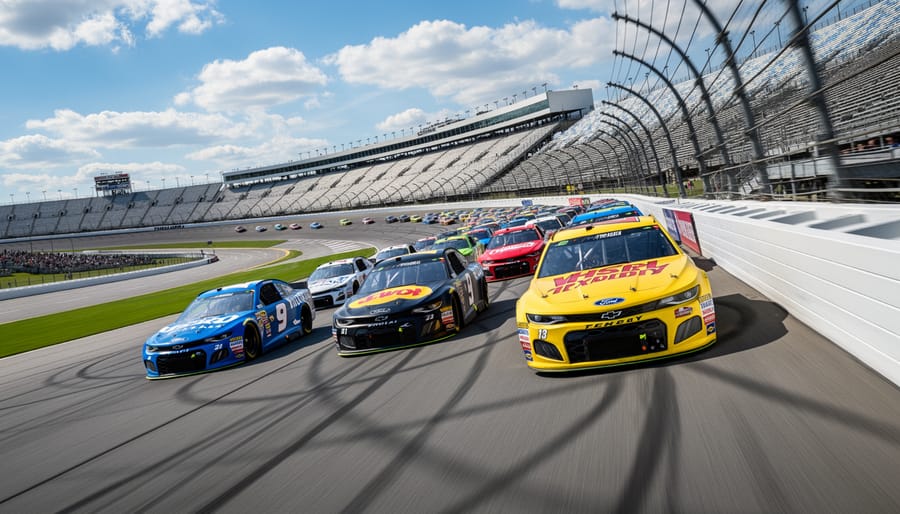
Talladega Superspeedway isn’t just big, it’s fundamentally different from every other circuit on the NASCAR calendar in ways that shape how drivers race and how teams strategize. At 2.66 miles around, it’s NASCAR’s longest oval, giving cars more time and space to build momentum before they hit the corners again. That length combines with a tri-oval configuration and banking that reaches 33 degrees in the turns and 18 degrees on the front stretch, creating sustained high-speed runs that would be impossible on shorter tracks.
What truly sets Talladega apart is the racing it produces. NASCAR mandates tapered spacers (previously restrictor plates) here to limit engine airflow and keep speeds from becoming genuinely dangerous on such a fast layout. That power restriction bunches the field into tight packs of 20 or more cars, often running three-wide and separated by inches rather than car lengths. Drivers become utterly dependent on drafting, using the aerodynamic wake of the car ahead to reduce drag and gain speed. A single car running alone loses momentum quickly; two cars working together in a draft can blow past the pack.
Several technical and racing factors make Talladega unique:
- 2.66-mile track length creates extended straightaways for drafting runs
- 33-degree banking in turns allows sustained high speeds through corners
- Tapered spacer restricts horsepower, compressing the field into pack racing
- Tri-oval shape offers multiple racing lines and passing zones
- Aerodynamic drafting becomes the primary competitive variable, not raw power
This combination makes Talladega unpredictable in a way no other track can match. Strategy shifts lap by lap as alliances form and dissolve, drivers jockey for draft partners, and positioning becomes a chess match at 190 mph. A car running 20th with three laps remaining has a legitimate shot at victory if the drafting breaks right. That’s why races here produce finishes decided by hundredths of a second and why a single wrong move can collect a dozen cars in what fans call “The Big One.” Talladega doesn’t reward the fastest car, it rewards the smartest drafting, the best timing, and sometimes pure luck.
The Physics Behind Talladega’s Wild Finishes
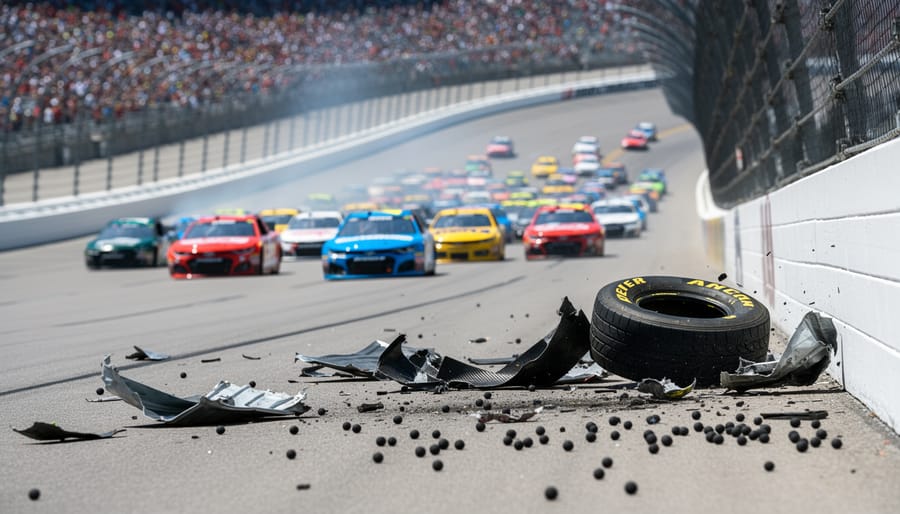
At speeds approaching 200 mph, Talladega transforms individual race cars into a single, interdependent organism. The aerodynamic forces at play create racing unlike anywhere else in motorsports, a delicate balance between cooperation and chaos that explains why a race leader can lose ten positions in seconds or why a mid-pack driver can suddenly rocket to the front.
The foundation of Talladega’s unpredictability lies in drafting. When a car punches through air at superspeedway speeds, it creates a pocket of lower-pressure air directly behind it. A trailing car entering this slipstream experiences dramatically reduced drag, allowing it to maintain the same speed while using less throttle, or to accelerate past the lead car by pulling out at the critical moment. At Talladega, this effect is so pronounced that two cars running nose-to-tail move significantly faster than either could alone.
Tapered spacers, which replaced restrictor plates in 2019, limit air entering the engine and cap horsepower at roughly 510. Without this restriction, cars would exceed 230 mph, speeds NASCAR deemed unsafe after multiple airborne incidents in the 1980s. The trade-off creates pack racing: since no car has enough power to break away alone, the entire field bunches into a multi-lane freight train where fifteen cars might run within a second of each other.
This compression creates the tactical complexity that defines superspeedway racing. Drivers form temporary alliances, pushing each other in two-car “tandems” or organizing into inside and outside lanes. These packs shift constantly as drivers jockey for position, testing aerodynamic partnerships. The same physics that enable dramatic slingshot passes also make the field vulnerable. When one car loses control in traffic, the tight spacing leaves nowhere to go. Cars behind can’t brake quickly enough; the aerodynamic wake disrupts handling for those alongside. What starts as a single spin cascades into “The Big One”, the multi-car crashes that have become Talladega’s defining hazard.
Modern broadcast coverage captures these dynamics through in-car cameras and telemetry overlays, though AI motorsport photos are increasingly revealing the split-second positioning decisions that separate clean finishes from wrecked playoff hopes. The physics haven’t changed, but our ability to analyze them continues evolving.
October 2026: What’s on the Schedule at Talladega
The October 2026 race weekend marks Talladega Superspeedway’s return to NASCAR’s playoff calendar, bringing championship drama back to the 2.66-mile superspeedway in Lincoln, Alabama. This three-day event runs from October 23-25, positioning it as a pivotal moment in the playoff chase where a single drafting mistake or well-timed push can reshape the entire championship picture.
Here’s the confirmed competition schedule for the weekend:
| Date | Time | Event |
|---|---|---|
| October 23, 2026 | 3:00 PM | Love’s RV Stop 225 |
| October 24, 2026 | 2:30 PM | The Progress Group 250 |
The Love’s RV Stop 225 on Thursday afternoon kicks off the weekend’s competitive action, giving fans an early taste of Talladega’s signature pack racing before the main event. Friday’s Progress Group 250 continues the superspeedway spectacle, showcasing how teams adapt their strategies across multiple races on the same surface.
What sets this October weekend apart is the timing. The Chase returned to Talladega’s fall date after the spring Jack Link’s 500 on April 26, 2026, meaning playoff-contending teams face the track’s notorious unpredictability when championship points matter most. A strong finish can vault a driver into the next playoff round. A crash in “The Big One” can end championship hopes in seconds, regardless of how dominant a team has been all season.
The schedule also includes the NASCAR Racing Experience, giving enthusiasts the chance to feel what 200-mph drafting actually means behind the wheel. For Canadian fans planning the trip south, the Thursday afternoon start provides travel flexibility from major cities like Toronto or Montreal, with competitive action spread across consecutive days rather than compressed into a single weekend sprint.
Talladega’s Role in NASCAR’s Playoff Picture
When Talladega appears on the playoff calendar, it functions as NASCAR’s great equalizer. Championship favourites can see their season unravel in a matter of seconds, while long-shot contenders suddenly find themselves with a genuine path forward. The October 2026 race arrives at a critical juncture, late enough in the playoff rounds that eliminations carry real weight, but early enough that multiple rounds still lie ahead.
The strategic calculus at Talladega differs fundamentally from every other playoff track. Teams that have built playoff cushions through consistent performance face a choice: race conservatively to survive the chaos, or push for stage points and track position that might prove vital later. Those already on the playoff bubble often adopt an all-or-nothing approach, knowing that Talladega’s pack racing gives them one of their best opportunities to steal a win and guarantee advancement.
History proves how dramatically Talladega can reshape championship battles. Dale Earnhardt Jr.’s 2015 win came during a period when he desperately needed playoff momentum. In 2016, Chase Elliott secured his first career win at Talladega during the playoffs, fundamentally changing his championship trajectory. More recently, teams have watched solid playoff runs disappear after getting collected in multi-car incidents they couldn’t avoid, victims of racing three-wide at 190 mph with nowhere to go when trouble erupted ahead.
What makes the October timing particularly consequential is that drivers have no margin for error. Unlike the spring Talladega race where teams can recover over a full season, an October DNF can immediately end championship hopes. This creates intense psychological pressure that amplifies the track’s inherent unpredictability, making every drafting move and every positioning decision carry playoff-elimination stakes.
Notable Talladega Moments That Changed NASCAR History
Talladega’s history reads like a highlight reel of NASCAR’s most dramatic moments, several of which fundamentally changed how the sport approaches safety and competition. The 1987 Bobby Allison crash stands as the pivotal incident that reshaped superspeedway racing. When Allison’s Buick became airborne after a tire failure, tearing through the catch fence and injuring spectators, NASCAR responded by mandating restrictor plates at Talladega and Daytona. This single moment created the pack-racing dynamic that defines these tracks today.
The 1993 DieHard 500 produced what many consider NASCAR’s closest finish ever, with Dale Earnhardt edging Ernie Irvan by .005 seconds, a margin that remained the official record for years. That photo finish demonstrated the breathtaking potential of plate racing when everything aligned perfectly, cementing Talladega’s reputation for nail-biting conclusions that kept fans on their feet until the checkered flag.
October 2006 brought carnage and controversy when a massive last-lap crash collected Brian Vickers, who was leading, and handed the win to Earnhardt Jr. The incident sparked renewed debates about acceptable aggression in the closing laps. More recently, the North Wilkesboro return reminded fans how historic track moments shape NASCAR’s identity, much like Talladega’s legacy continues to influence the sport.
Safety innovations followed the track’s most frightening incidents. The introduction of SAFER barriers, upgraded catch fencing, and improved car designs emerged partly from lessons learned at Talladega. These improvements haven’t eliminated risk, multi-car pileups remain an inherent possibility, but they’ve made the spectacular racing survivable, allowing drivers to walk away from crashes that would have been catastrophic decades earlier.
How Canadian NASCAR Fans Can Experience Talladega
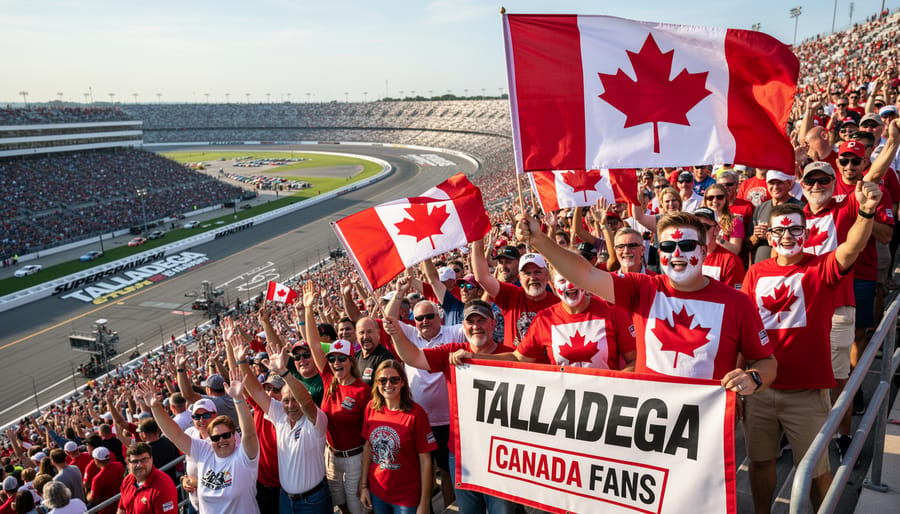
Canadian NASCAR fans have several compelling reasons to engage with Talladega racing, whether from home or making the trip south. The track’s reputation for unpredictable finishes translates exceptionally well to television, making superspeedway races the most consistently engaging broadcasts on the NASCAR calendar. You’ll watch the entire field stay bunched together for hours, creating sustained tension that road course and short track events can’t match.
For those considering attendance, the October race weekend sits during a manageable travel window. Toronto to Birmingham, Alabama (the closest major airport, roughly 50 miles from the track) typically requires one connection through U.S. hubs. Montreal and Vancouver fans face similar routing. The Canadian trip tips cover border crossing essentials and accommodation strategies for race weekends when Lincoln’s limited hotel inventory fills quickly.
- Book flights and accommodations three months ahead for October playoff races
- Consider Birmingham hotels with shuttle services rather than Lincoln properties
- Bring ear protection, even for grandstand seats away from pit road
- Download the NASCAR mobile app for live scanner feeds and timing data
- Pack for variable Alabama weather in late October
The Canadian motorsports community has embraced superspeedway racing differently than the Canada road course technical precision that defines our domestic racing culture. Talladega represents spectacle over finesse, chaos over consistency. That contrast explains its appeal. You’re watching a completely different racing formula, one where a mid-pack car can win through drafting strategy alone and where favorites wreck through no fault of their own. For Canadian fans accustomed to road racing discipline, Talladega offers pure entertainment value.
Talladega Superspeedway stands apart in NASCAR’s calendar precisely because it refuses to follow a script. The combination of extreme speeds, pack racing dynamics, and split-second drafting decisions creates an environment where past performance and championship points can evaporate in a single corner. That’s exactly what makes the October 23-25, 2026 race weekend so compelling. With The Chase returning to Lincoln, Alabama during playoff season, every lap carries championship consequences, and even the most calculated strategies can unravel when forty cars are running three-wide at nearly 200 mph.
For motorsports fans across North America, Talladega delivers something increasingly rare: genuine unpredictability. Canadian NASCAR enthusiasts particularly appreciate how superspeedway racing levels the competitive field, creating moments where smaller teams can challenge powerhouses and underdogs can steal victories. As NASCAR continues evolving its technical regulations and safety standards, Talladega remains the ultimate test of nerve, timing, and calculated risk-taking. The track’s ability to generate drama hasn’t diminished over decades of racing, and the October weekend will likely add another chapter to that legacy. Whether you’re trackside in Alabama or watching from Toronto, Talladega guarantees one thing: you won’t know how it ends until the checkered flag drops.